


In 2012, I watched a bank nearly die.
I was CTO for a financial institution that processed half of a country’s transactions. Over 20,000 engineers reported up through my org, and the IT budget ran to roughly $5 billion a year.
One morning, during a large database migration, the core system crashed. Cards stopped working at gas stations, ATMs went dark, and millions of people were locked out of their money. It made national television within an hour.
My senior engineering team asked for four hours to run safe diagnostics and restore from backup (which was standard procedure). But I knew that a four-hour blackout for a bank that half a country depended on would permanently destroy its reputation. Customers don’t come back after that.
Then an engineer named Alex proposed something different. A risky, unverified patch that had never been tested in production. If it worked, recovery in minutes but if it failed, it could wipe the ledgers entirely…maybe crash the system for a week.
I told Alex to push the button.
Luckily it worked and the system came back in minutes.
Afterward, I called my CEO fully prepared to resign and take accountability. His response: “Shut up... just go and solve the problem.”
I tell this story because it shows what people outside banking consistently underestimate. Banks are survival machines. Every compliance department, risk committee, licensing regime exists for one reason: these institutions hold society’s money, and when they fail, the damage spreads far beyond their walls.
That survival instinct is baked into everything they do. Every process, every approval layer, and audit trail assumes a human is on the other end, accountable for what happens next.
Now think about what the agent economy actually requires. We are asking these same institutions to let autonomous software agents move real money through their systems. Billions of agents, transacting by the millisecond, forming temporary relationships with other agents and dissolving them just as fast. No human in the loop for most of it.
Here’s where two problems collide. The payment infrastructure those agents would run on, Visa, Mastercard, ACH, SWIFT, even Stripe, was built assuming a human initiated every transaction. It physically cannot handle machine-speed volumes.
And at the same time, the institutions that control those rails have an entire risk culture built around human accountability. Someone signs, approves and is responsible when things go wrong. But agents don’t fit that model.
So you can’t solve one without the other. Faster pipes alone don’t work if the banks operating them have no way to trust what’s flowing through. And institutional trust alone doesn’t work if the rails underneath collapse under the volume.
Both problems have to be solved together before the agent economy can function at any real scale.
The pipes were built for humans
Everyone in venture capital is chasing LLM benchmarks and GPU clusters right now. Fair enough. But underneath the intelligence race, there’s a structural problem forming that most people aren’t paying attention to.
The scale is hard to estimate. McKinsey projects that AI agents could orchestrate $3 trillion to $5 trillion in global B2C retail revenue by 2030. Juniper Research forecasts $1.5 trillion in agentic commerce spend by the same year. The gap between those numbers is itself the most useful data point. Nobody actually knows but even the low end demands infrastructure that just doesn’t exist today.
Here’s the problem: an AI agent can compare 10,000 offers, negotiate terms, and select the optimal vendor in seconds.
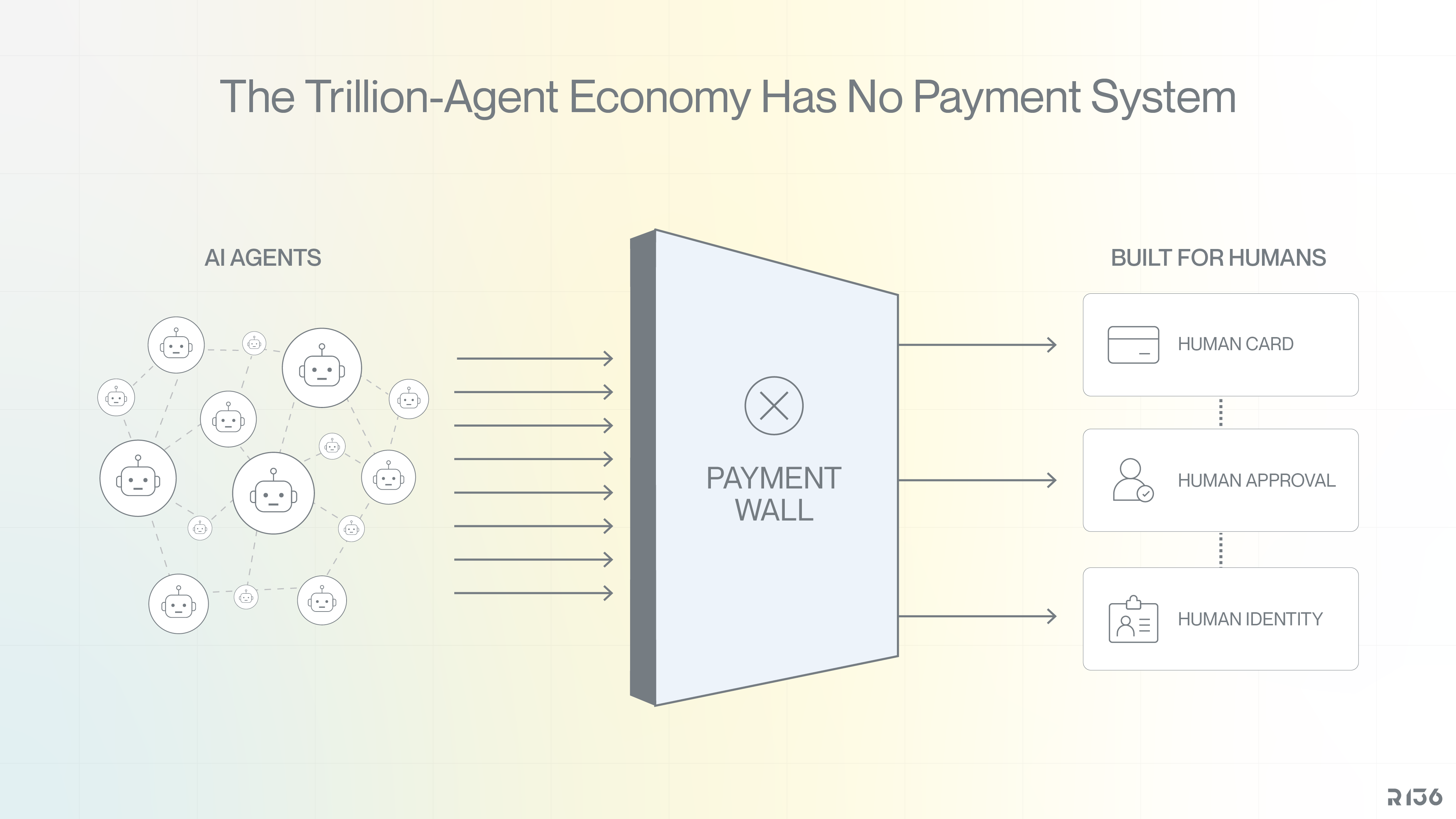
Then it hits a payment wall so it needs a human’s card, a human’s approval and a human’s identity. The agent that just outperformed an entire procurement team sits idle, waiting for someone to type in a credit card number.
Most people think a payment is one event but it’s actually three separate processes: authorization, clearing, and settlement. They happen at different times, through different systems, governed by different rules. When you tap your card at a coffee shop, the authorization feels instant. The actual movement of funds between banks settles hours or days later in batches.
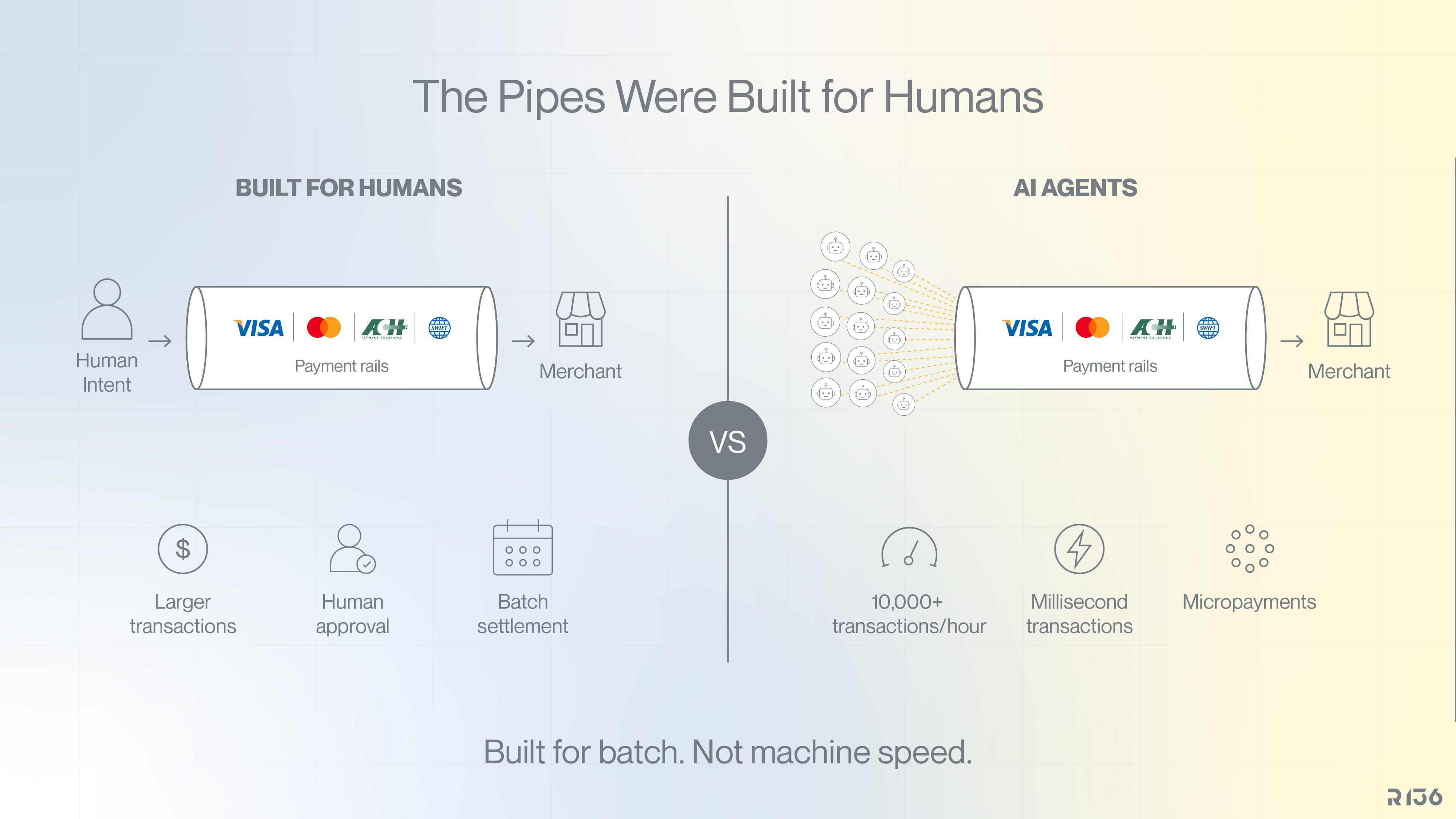
That batching made sense for decades. Human transaction volumes are pretty manageable. They might make ten purchases a day, each worth several dollars, each producing behavioral signals that fraud systems can evaluate. Location, typing speed, purchase history. The interchange fee on each transaction is easily absorbed because the transaction itself is large enough.
But now imagine an enterprise AI agent tasking 50 specialized sub-agents with writing, compiling, testing, and deploying a software patch in real time. To complete this, the primary agent needs to hire, negotiate, and instantly pay those fifty agents for compute loads measured in milliseconds.
Under current rails, a $0.0001 micropayment gets swallowed by a transaction fee that can be multiples of the payment itself. You’re paying more to move the money than the money is actually worth.
ACH processed $104 trillion in 2024, representing 74% of all U.S. noncash-payment value. That’s an extraordinary system. But Same Day ACH operates on three settlement windows during business hours and shuts down on weekends and federal holidays. If your agent fleet needs compute resources at midnight on a Sunday, too bad.
Swift moves 13.4 billion messages a year. But Swift is a messaging layer. The actual friction comes from the correspondent banking chain underneath: multiple intermediary banks, each adding compliance checks, each operating in different time zones, each holding funds in transit. For a cross-border agent transaction that needs to settle in milliseconds, that architecture adds days.
These systems are genuine engineering achievements, they work at enormous scale. But they were optimized for a world of larger, less frequent, human-authorized transactions. An agent making 10,000 micro-purchases per hour just wasn’t in the design spec.
What invisible infrastructure actually looks like
In 2001, long before the iPhone existed, my team built a mobile banking system in Eastern Europe. Phones were expensive and clunky and with primitive internet connectivity. So we built a system that ran entirely on SMS text messages.
A user would type something like “Send 500 rubles to +7-123-456-7890 for dinner” and money moved. No ap or login screen or dashboard.
What surprised us is that users hijacked the system to flirt, to communicate, to have conversations where the payment was the excuse and the message was the point. Money became a language.
I think back on this because it taught me something I think most people in tech still underestimate. We succeeded because we relied on communication, on the simplest possible interface.
We weren’t actually building a banking app. We were building a way for people to talk to each other using money. And we hid the massive database complexity of early 2000s banking systems behind a twelve-word text message. A million people used it without thinking about what was happening under the surface.
The lesson for the agentic era is the same. The best infrastructure is invisible.
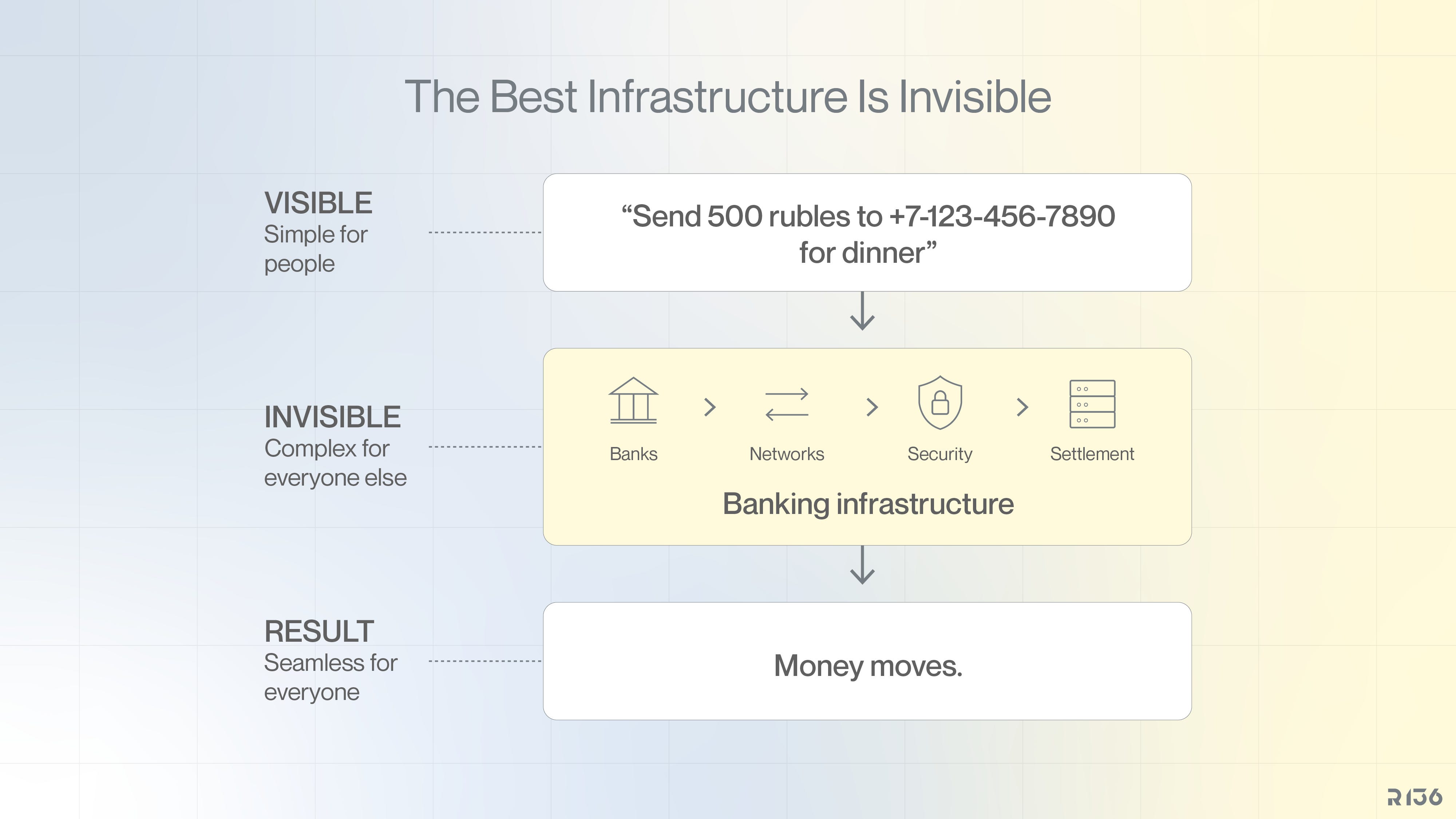
Tomorrow’s agentic rails need to hide the complexity of machine-to-machine billing the same way that SMS system hid the banking stack. The human user shouldn’t see individual ledger settlements, clearing pipelines, or API calls. The agents should communicate, transact, and settle autonomously in the background. Value flowing as seamlessly as electricity.
The protocol race is already underway
The biggest companies in payments are now building this. They’re further along than most people realize.
In the last 18 months, every major payments player launched an agentic commerce initiative. Nobody is building the same thing. Think of it as layers of a new stack. At the bottom, MCP connects agents to APIs and data sources. One layer up, Google’s A2A protocol lets agents discover and coordinate with each other across platforms.
OpenAI and Stripe built ACP to structure how agents browse catalogs, manage carts, and check out. Google separately launched UCP to cover the full commerce lifecycle from product discovery through post-purchase support.
Then there’s the authority layer (this is where things get genuinely interesting). Google’s AP2 protocol, backed by more than 60 organizations including PayPal, uses cryptographically signed mandates to create provable evidence that a human authorized a specific transaction under specific constraints.
This is the piece that matters most for the trust problem I described earlier. It’s scoped, time-limited, auditable delegation. Not “give the machine your credit card.”
At the execution layer, Stripe’s Machine Payments Protocol uses HTTP 402 payment challenges for machine-to-machine purchases. When one agent needs to buy a resource from another, the server responds with a payment challenge instead of an error page. The buying agent resolves it programmatically. No checkout flow. No cart. Just a protocol-level exchange that settles the transaction.
The incumbents are moving fast. Mastercard launched Agent Pay in April 2025, then expanded with Agent Pay for Machines in June 2026, supporting micro-value, high-frequency transactions across cards, bank accounts, and stablecoins. Visa is developing agent-identification mechanisms.
PayPal released an Agent Toolkit and joined AP2. Santander and Mastercard completed Europe’s first live end-to-end payment executed by an AI agent. Robinhood opened its platform to AI agents in May 2026.
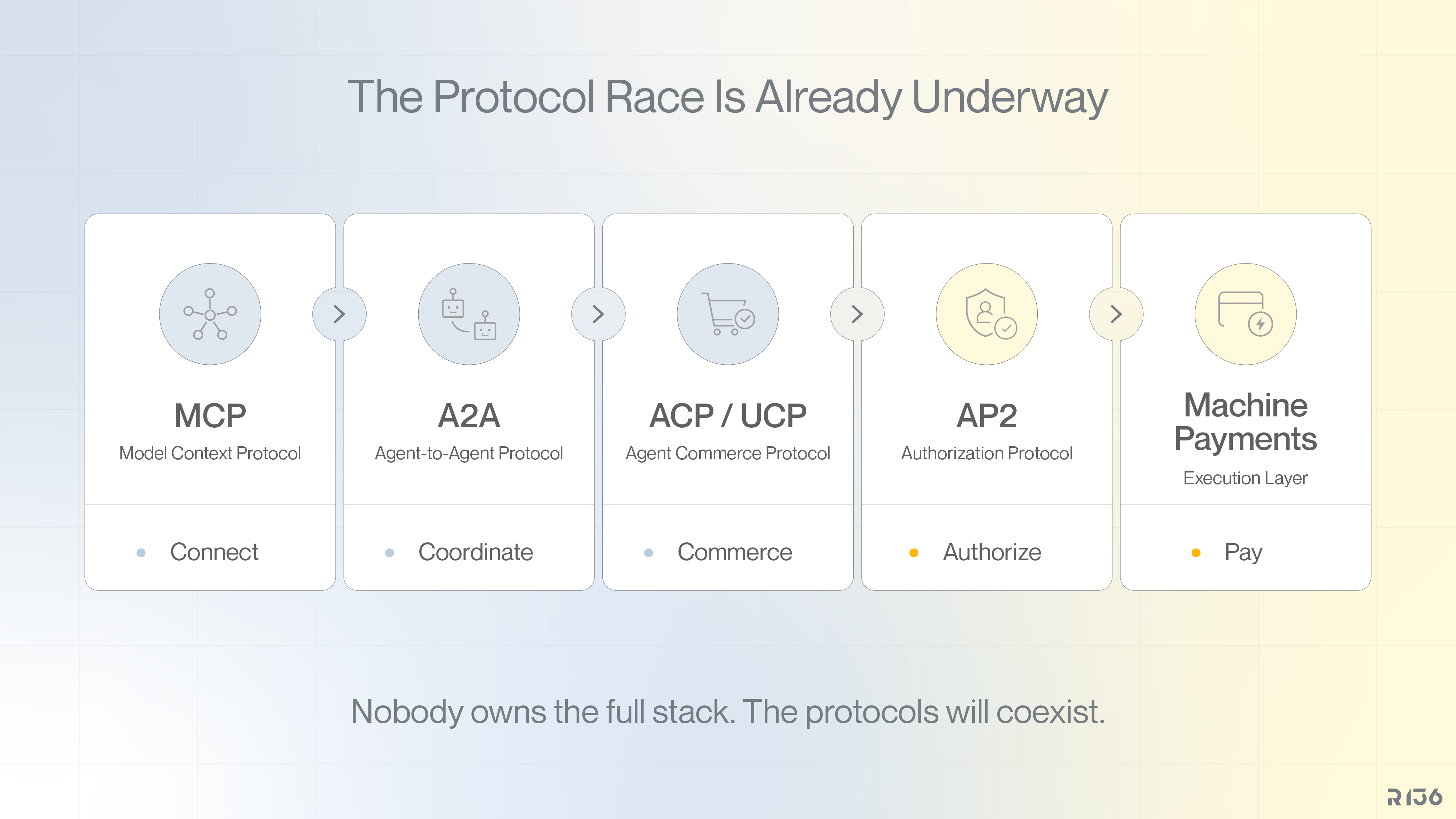
Nobody owns the full stack. These protocols overlap, compete, and will probably coexist for years. The likely outcome is gateways that translate between them. And that translation layer, the middleware for non-human commerce, is itself an enormous opportunity.
Trust is the real infrastructure
Protocols solve the conversation between agents and merchants. But the hardest question isn’t technical.
When an agent buys the wrong thing, who absorbs the loss? Maybe the user gave an ambiguous mandate, or the agent misinterpreted it. Maybe a merchant manipulated the agent’s decision-making or credentials were stolen.
Card chargebacks protect consumers today, but they were designed for a human calling their bank to dispute a charge. Not for machines generating thousands of micro-exceptions per hour where the investigation cost for each one exceeds the transaction value.
Cryptographic mandates like AP2 improve the quality of evidence. They create a provable record of what the human authorized. But they don’t by themselves settle legal liability when the agent’s interpretation diverges from what the human actually intended.
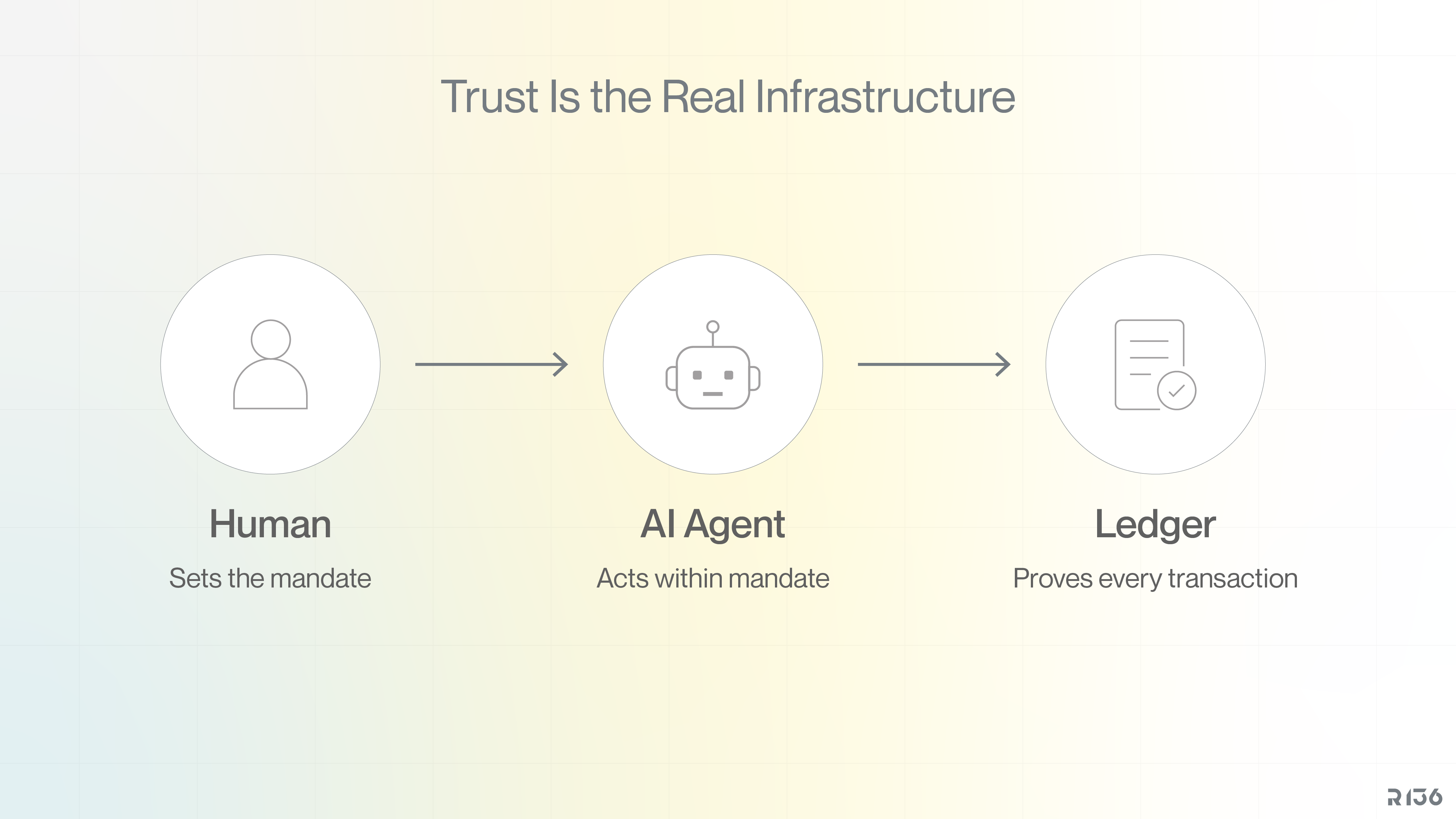
I spent 20 years inside banking systems. The real infrastructure underneath any payment system is the liability framework which answers the question - who bears the loss when something goes wrong. Every payment system in history had to answer this question before it could scale. Agent payments won’t be different.
The trillion-agent economy cannot exist until we solve a specific problem: strict, real-time auditability built directly into the ledger. Every transaction traceable, every agent accountable, every mandate provable.
Because when the system crashes (and at some point it will) someone has to explain exactly what happened and why. That someone can’t be an AI that hallucinates its own audit trail.
Where the value concentrates
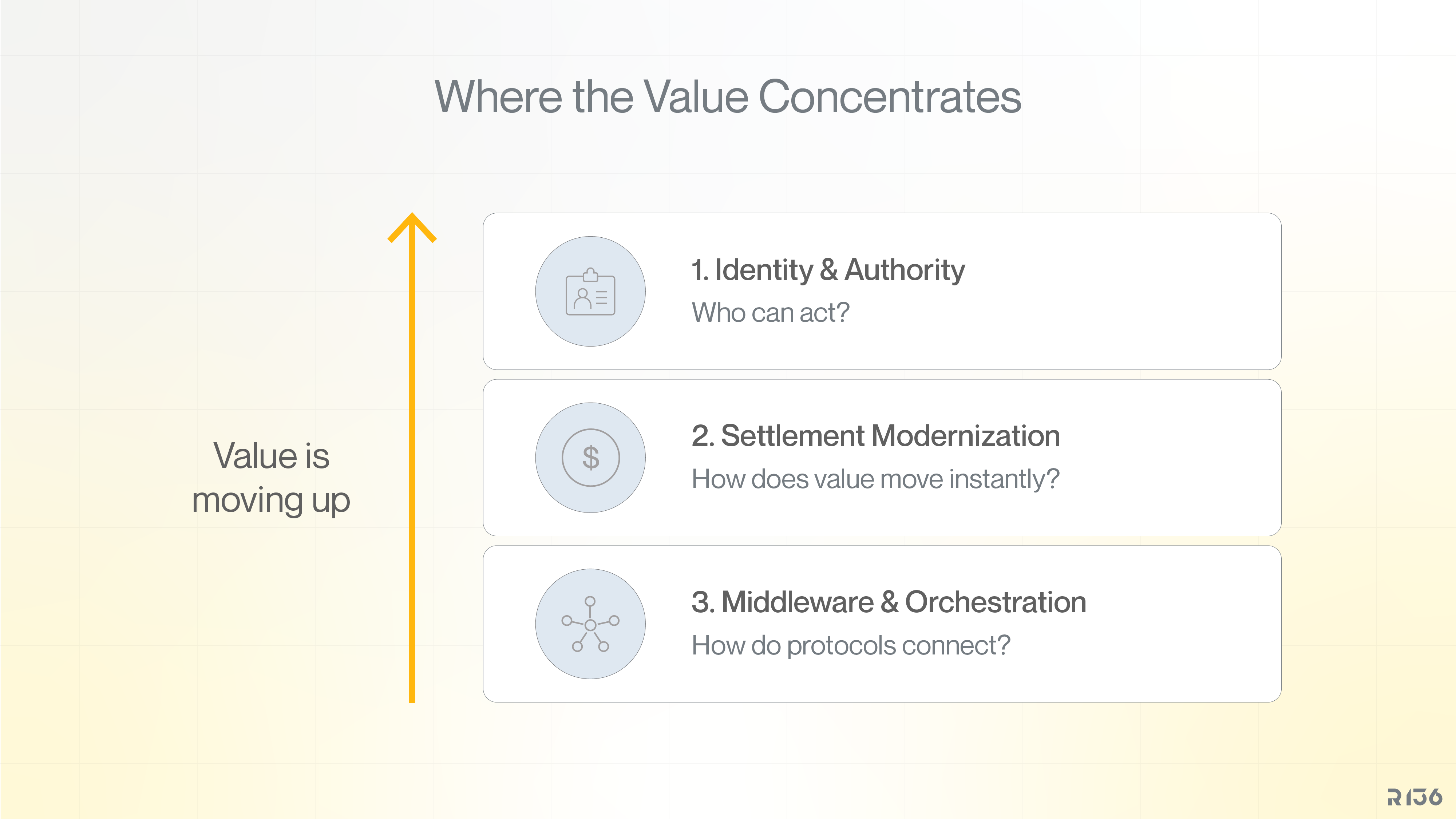
The AI models themselves are becoming cheaper fast. The value is moving to the layers above them. I see it concentrating in three places.
Identity and authority
The core question: how do you verify who an agent is and what it’s allowed to do? And can you prove that after the fact? The U.S. National Institute of Standards and Technology is already working on standards for how agents identify themselves and get permission to act.
Google’s payment authorization protocol and Mastercard’s system for proving what a human actually approved are early answers. Most large companies already have far more machine accounts than human ones. Tens of thousands, sometimes millions. And the identity systems we rely on were built for people with usernames and passwords. That gap has to close.
Settlement modernization
Money needs to move instantly, around the clock, with no batch processing delays. Several approaches work for different situations. Stablecoins handle cross-border payments and recurring digital services well. The GENIUS Act, signed July 2025, creates the first real U.S. federal framework for stablecoins used as payment.
The full operational rules don’t kick in until January 2027, but the legal direction is already set. Instant bank transfers cover other flows. And for big institutional deals where multiple parties need to settle privately and in sync, specialized networks are being built. The right answer is probably all of them, coexisting.
Middleware and orchestration
I already described how many competing protocols already exist. So somebody has to build the connectors between them. The gateways that let an agent using one protocol talk to a merchant using another, and settle the payment across whatever rail makes sense. Think of it as the translation layer for non-human commerce. Given how fragmented things already are, whoever builds that sits in a very valuable position.
What I see up close: Airwallex is building AgentOS, a set of tools that lets AI agents do real financial operations. Check balances. Send payments. Create invoices. Issue virtual cards. Handle currency conversions across accounts. The interesting part is the guardrails they built in.
Anything that actually moves money, transfers, payouts, currency exchanges, requires human approval by default. An agent can look up information and prepare transactions all day. But before money leaves an account, a person has to sign off.
That’s what responsible agent finance looks like at this stage. Let the machines handle the complexity, keep humans in control of what matters. (Disclosure: R136 Ventures is an investor in Airwallex.)
Digital Asset’s Canton Network solves a different piece. Canton is a settlement network built for institutions. Its key feature: when two sides of a deal are linked, both go through or neither does. No half-completed transactions.
If I’m selling you a bond and you’re paying me cash, both legs happen together, or the whole thing rolls back. That sounds simple but matters enormously when agents start creating thousands of linked deals per second across systems that don’t naturally talk to each other.
Broadridge runs hundreds of billions in daily repo transactions on Canton. DTCC partnered with Digital Asset to turn U.S. Treasuries into digital tokens on the network. When the volume of linked obligations outpaces what today’s separate record-keeping systems can handle, synchronized all-or-nothing settlement becomes the only way forward. (Disclosure: R136 Ventures is an investor in Digital Asset.)
When owning and spending become the same thing
Follow this thread to its end and something bigger takes shape.
Real-world assets are gradually being turned into digital tokens. Stocks, real estate, intellectual property. When that process reaches sufficient scale, the line between owning something and spending it starts to disappear.
An AI agent won’t need to sell a stock position, wait for settlement, transfer the cash to a bank, and then send a payment. The agent will instantly swap a fraction of a tokenized S&P 500 share to pay another agent for a millisecond of computing time.
That’s what full financial velocity looks like. Everything becomes liquid. Every asset can be exchanged directly for any other asset, settled in the same moment. The old distinction between money and property fades into a single layer where everything is programmable and everything moves.
We’re not there yet. And maybe we wont be for years but the regulatory framework is forming. The GENIUS Act and the EU AI Act’s transparency obligations. The institutional plumbing is being laid and the protocols keep multiplying.
But the direction is clear.
The companies building the identity layer, the settlement layer, and the liability framework for machine transactions right now are building the rails that everything else will run on.
I learned this in 2001, watching a million people send money through twelve-word text messages on Nokia phones. I learned it again at 3 AM in 2012, telling Alex to push the button on a patch that had no right to work. The technology changes every few years. The plumbing always matters more than the interface. That hasn’t changed once.